

THE RED BULL RING DID NOT REWRITE THE HIERARCHIES

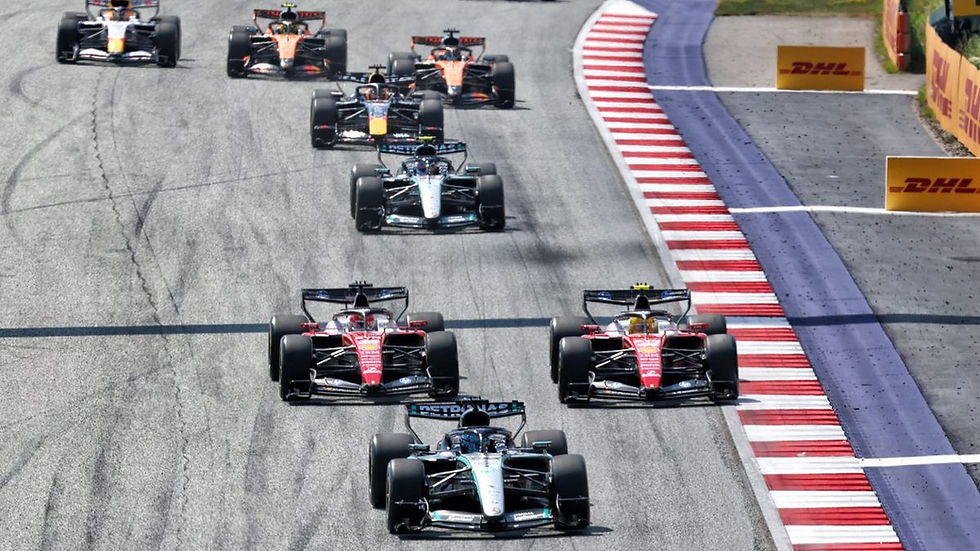
The Austrian GP at the Red Bull Ring left plenty of talking points. From Russell’s victory—arriving exactly when it mattered most and effectively answering Kimi’s first real strikes—to Verstappen’s second place, which inevitably reopens a question: is Red Bull truly back, or did this circuit simply amplify its strongest traits? And then there is Ferrari, once again under the spotlight, suspended between enthusiasm and disappointment.
But if there is one sentence I keep coming back to when analyzing weekends like this, it is always the same: the problem is not the result, the problem is expectations.
We arrived in Austria wrapped in a very specific narrative: an updated Ferrari power unit, the possibility of reopening the championship fight, and the feeling that this weekend could represent a turning point. The issue is that when the starting point becomes that ambitious, any normal outcome risks being perceived as a failure.
Yet a single race does not erase the previous six, nor does it define the rest of the season on its own.
Looking at what we had seen up to this point, a weekend like this was far from unpredictable. For months, the advantage of Mercedes and Red Bull in terms of power unit performance and energy management has been widely discussed. Arriving at one of the most engine-sensitive circuits on the calendar and expecting a complete reversal of the hierarchy was probably unrealistic.
For this reason, more than a surprise, this weekend felt like a confirmation to me.
Mercedes once again showed it has an extremely competitive power unit, but above all something that today is almost more valuable than aerodynamic upgrades: an energy management system that still looks like the real differentiating factor under these regulations. When you can deploy and recover energy more efficiently than others, the overall gain can outweigh even significant updates to wings or floor.
On the other side, Red Bull also deserves a different kind of reading than the one often proposed. It may not have the outright benchmark unit of the field, but continuing to describe its thermal performance as inferior to the rest is starting to feel like an oversimplification.
In a sense, this race also provided early confirmation of some evaluations made in recent weeks regarding energy balance. Evaluations that are often twisted into theories about regulatory advantages for whoever happens to be winning at the time. The pattern is always the same: the name changes, but the narrative does not.
The track, however, almost always brings things back to a more grounded reality.
Even looking at Racing Bulls versus Alpine, some interesting signals emerge. On a circuit like the Red Bull Ring, these differences become more visible and suggest that the Red Bull Powertrain project is likely much closer to the front than many are willing to admit.
In the end, though, the overall benchmark remains Mercedes, because beyond the engine itself, it combines energy efficiency, car balance, and package exploitation in a way others still struggle to match.
McLaren is also an interesting case.
Piastri’s fourth place may suggest a clear advantage over Norris, but a closer look at the race shows the gap was far less pronounced. The key moment came on lap one: the attempt on Verstappen, the less effective exit from Turn 3, and Oscar’s pass completely changed Norris’s race. From that point on, he was forced into recovery mode, running a different strategy and extending his first stint more aggressively.
Overall, however, the feeling is that McLaren today has characteristics closer to Ferrari than to Mercedes. It certainly has more straight-line speed than the SF-26, but it still shows some energy-management limitations—albeit milder ones—in the same areas of the track.
Now we head to Silverstone, which may turn out to be one of the most interesting weekends of the year.
Because, after hours of simulation work, one question keeps coming back to me: how will these cars really handle the run into Copse and especially the full Maggots–Becketts–Stowe sequence?
Corners like these deserve to be attacked. Not managed.
© Simone Marchetti Cavalieri


